Sony Can Delete What You Bought. Ripping Your Own Blu-ray Is the Crime.
Sony will wipe 551 purchased films from PlayStation libraries on Sept 1, kill discs in 2028, and the DMCA still makes backing up your own Blu-ray a felony.
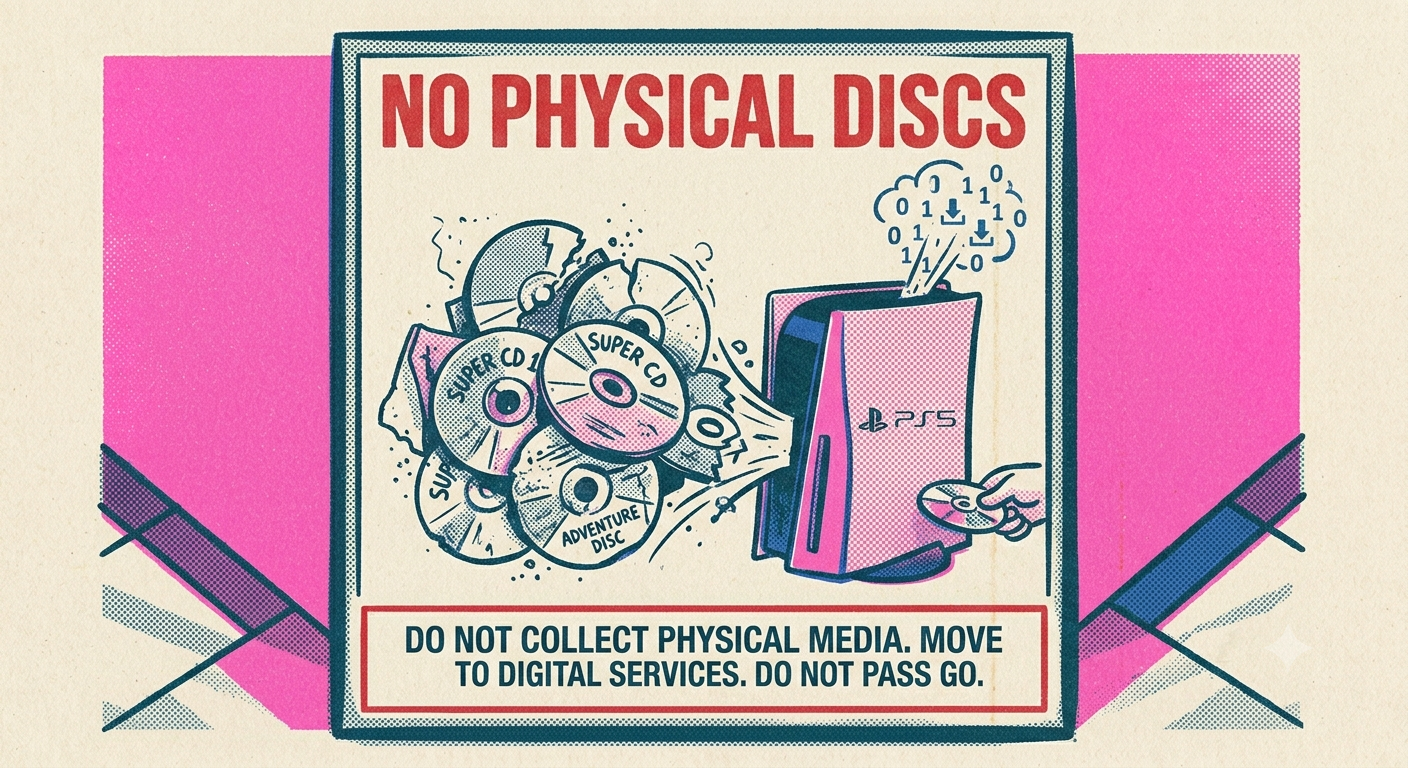
A PlayStation Store 'Buy Now' button next to a padlocked Blu-ray disc — the two ends of a legal regime that lets a corporation take back what you paid for while criminalising the one thing you could do to protect yourself.
On September 1, 2026, Sony will delete 551 Studio Canal films — Terminator 2, Total Recall, Apocalypse Now: The Final Cut, Highlander, Pan's Labyrinth — from the PlayStation video libraries of customers who paid for them. No refunds. The day before yesterday, Sony announced it would stop producing physical PlayStation discs entirely in January 2028. And under Section 1201 of the DMCA, if you rip your own legally-purchased Blu-ray to keep a backup, you are the one facing federal prosecution.
Three separate announcements. One trap closing.
What Sony's Terms of Service Actually Say
Buried on page 26 of the PSN Terms of Service is a single sentence that empties every consumer-facing word Sony prints on its store:
"Use of the terms 'own,' 'ownership,' 'purchase,' 'sale,' 'sold,' 'sell,' 'rent' or 'buy' in this Agreement or in connection with the Content does not mean or imply any transfer of ownership."
Every "Buy Now" button on the PS Store asks you to consent to that clause. The button says one word, the terms say the opposite, and Sony has counted on the gap for years — the same way Ubisoft has argued that you never owned your games in the first place. This is the third time Sony has cashed the clause in on a video library. German and Austrian customers lost their Studio Canal titles in 2022. US customers were told they'd lose Discovery content on December 31, 2023 — Sony walked that one back after the backlash. Now UK and European customers get the sequel on September 1, 2026, and Louis Rossmann's video on it is the clearest walkthrough of what's actually happening.
I've written before about Sony's 30-day online check-in locking your PS5 game library, and Microsoft doing the same thing to Office 2019 buyers. The pattern is not new. What is new is that Sony has stopped bothering to hide it.
The DMCA Asymmetry
Here is the part that makes the whole system rotten. Sony can license content it does not own, sell you "access" using words that imply ownership, and delete that access years later without a refund. Zero criminal exposure. It is a business model.
If you own the same movie on a Blu-ray you paid cash for at a physical store, and you rip a copy to your laptop so you can watch it on a plane, you are violating 17 U.S.C. §1201. The DMCA's anti-circumvention clause makes it illegal to defeat the DRM even for personal use. Fair use is not a defense. Criminal penalties under §1204 reach $500,000 or five years in prison for a first offense, and ten years for repeat violations. The person who writes the tool that lets you decrypt your own disc faces the same statute.
Read that back. A consumer who backs up media they actually own, using a device they paid for, on hardware sitting in their own house, can go to federal prison. A corporation that licenses content it does not own, sells it using the word "purchase," and revokes it without refund is legally clean. That is not a bug in the copyright regime. That is what the copyright regime does.
The Trap Just Closed
On July 1, Sony announced that from January 2028, no new PlayStation game will ship on a physical disc. Retail boxes will contain download codes. The single mechanism that historically protected buyers — handing over money at a shop and leaving with an object you owned — is being retired for the medium Sony still controls.
Put the three pieces together: digital purchases are legally revocable, physical discs are being phased out, and self-help is a federal crime. As someone who works in enterprise tech, I have watched software licensing tighten this way for a decade, and I know exactly what the endgame looks like. When the only thing left is a subscription, the only thing left is a subscription.
Rossmann Is Right
I do not say this lightly, because I pay for the things I value — Blu-rays, books, indie games. What I refuse to do is pretend the transaction I am being offered is the transaction I am actually getting. A "purchase" that can be deleted, on a platform killing the alternative, under a legal regime that criminalises my ability to keep what I bought, is not a sale. It is a rental with the word "sale" printed over the top.
Sony is being sued in California right now under AB2426, a 2025 law requiring stores to disclose when a "Buy Now" button is actually a licence. Four gamers filed the class action on June 18, 2026. The lawsuit is not a fix. It is a tell — the legal system has finally noticed the language fraud. Until the DMCA is reformed and TOS clauses like Sony's page 26 are unenforceable the way "we are not liable for anything ever" boilerplate is unenforceable, Rossmann's framing is the honest one. If Sony is allowed to take back what you paid for, and the law criminalises the one thing you could do to protect yourself, piracy is not the moral failure in this story.
The moral failure is a business model that needs the state to prosecute you for keeping what you bought.